
A new Saguache exhibition celebrates the life and art of Ramblin' Roy Smith
This item is available in full to subscribers.
At this time, we ask you to confirm your subscription at www.themtnear.com, to continue accessing the only weekly paper in the Peak to Peak region to cover ALL the news you need! Simply click Confirm my subscription now!.
If you are a digital subscriber with an active, online-only subscription then you already have an account here. Just reset your password if you've not yet logged in to your account on this new site.
Otherwise, click here to view your options for subscribing.
Questions? Call us at 303-810-5409 or email info@themountainear.com.
Please log in to continue |
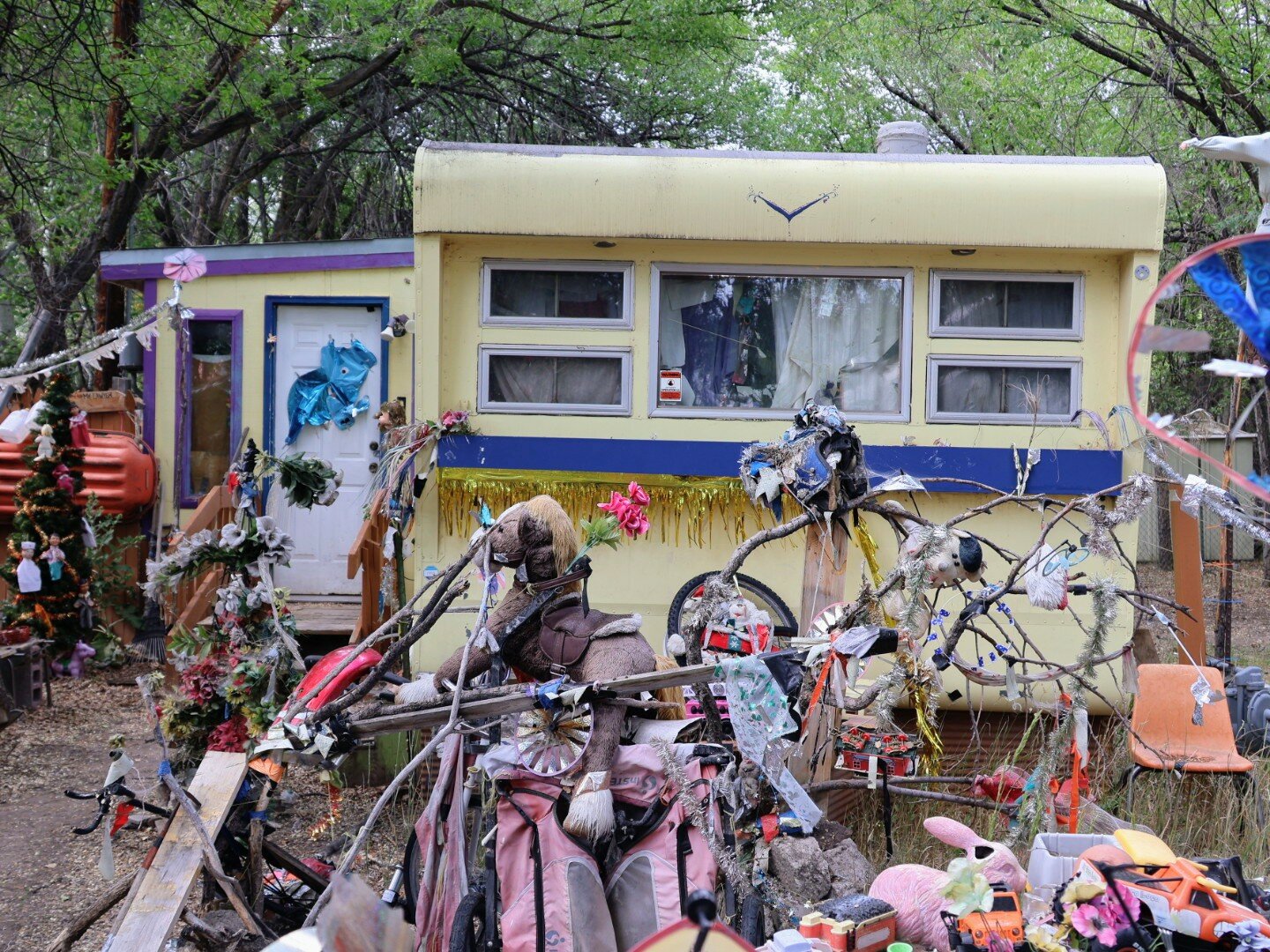
"Royville," where Roy Smith spent his final years, remains much as he left it in Saguache.

A full-length assemblage figure made from found materials stands in the gallery.

A gallery visitor stands beside one of Roy Smith's wearable pieces.

A person looks at a whimsical assemblage hanging from the gallery ceiling on July 10, 2026.

A toy horse and rider are incorporated into one of Roy Smith's works.

One of Roy Smith's creations includes a vintage toy figure waving hello.

A photo collage made by Roy Smith, of Fred Scruton's photos of Roy, surrounded by his artwork inside the Saguache Royville.

A doll adorned with jewelry and found objects is featured in the exhibition.

A toy train becomes part of one of Roy Smith's imaginative creations.

A photo by Scruton of Roy and Connie Chung hangs on the wall of his trailer in Saguache.

Candy wrappers and photographs became part of Roy Smith's assemblage art, often layered into his collages and sculptures.

A painting of a younger Ramblin' Roy Smith by Gloria Riddle-Roe welcomes visitors to the exhibition.

One of Roy Smith's life-size figures is on display at The Range in Saguache.

A child figure created from fabric, found objects, and glue is among Roy Smith's assemblages.


SAGUACHE — At first glance, the humble walls of The Range are filled with colorful dolls, collages, weathered sculptures, and odd collections of everyday objects. Look a little longer, though, and the exhibition becomes something more. Every piece tells part of the story of Ramblin' Roy Smith.
Roy grew up in Gunnison, Mississippi, before heading west to Colorado in the 1970s, where he lived in Central City, Salida, Questa, and eventually Saguache.
The exhibition, "Ramblin' Roy Smith: Feelin' Like a Tumbleweed," opened Friday, July 10, at The Range, 307 4th Street, where it will remain on display through September 13.
The show brings together dozens of Roy's assemblage pieces, offering visitors a glimpse into the life of an artist who saw beauty and possibility in the things most people threw away.
Some might casually call it "trash art," but curator Adrienne Garbini prefers the term “assemblage.” The large standing pieces in the gallery look like scarecrows or ghostly clothed figures with no bodies, adorned with all kinds of doo-dads and tchotchkes.
Roy worked with almost anything he could find. Toys, scraps of wood, buttons, jewelry, fabric, old photographs, and packaging all found their way into his creations. He even saved wrappers from his favorite candies and snacks, incorporating them into sculptures that became part autobiography and part artwork.
He also believed art needed time. New materials didn't stay new for long, and he preferred old stuff, things people would have thrown away.
Roy liked leaving pieces outdoors until the San Luis Valley sun baked them into faded colors and dusty textures. Garbini laughed as she explained that if something hadn't been "cooked" long enough, it simply didn't look finished to Roy.
The gallery displays about 60 works and archival pieces, including photographs by longtime collaborator Fred Scruton and a portrait of Roy painted by Gloria Riddle-Roe while he was living in the spot in Salida known as “Royville.” Together, they tell the story of a man who spent decades creating art wherever life carried him.
Each time Scruton visited, he later mailed Roy a fresh stack of photographs. Roy transformed those images into new works, cutting them apart and weaving them into his assemblages until the photographs became as much a part of “Royville” as the dolls, toys, and weathered wood.
After touring the exhibition, Garbini asked if I wanted to see the Saguache Royville. I wholeheartedly agreed.
We drove only a few blocks from the gallery to the trailer where Roy spent the last years of his life. The yard was full of unique decorations—a dune buggy, toy displays, windmills, and an old rocking chair covered in webs. The inside was absolutely teeming with art; it was on the walls, the ceiling, the shelves, and the tables.
She explained that this wasn't the only “Royville.” Nearly every place Roy settled eventually became another “Royville.” He moved around the San Luis Valley like a tumbleweed.
Friends estimate there may have been six Royvilles over the years, stretching from Central City to Salida, Cuesta, and finally Saguache.
Today, only two remain: the trailer in town and the original Royville about 20 miles north of Saguache.
Opening the trailer door felt like stepping into another time. There was a feeling of a bygone era, something magical locked in place. The musty trailer seemed to preserve Roy exactly as he left it.
Every crowded shelf, handmade doll, weathered sculpture, and pile of collected treasures spoke of his unique life. In its own way, the place screamed from within his lamentations, accomplishments, happiness, and wonderfully distinct way of living.
Unlike a museum exhibit arranged behind glass, Royville still feels lived in. His tiny home doubled as his studio, where he glued together dolls, stitched clothing, built sculptures, and surrounded himself with the objects that inspired him. Garbini said he loved creating and decorating clothing.
Much of what filled the trailer came from thrift stores, dollar stores, flea markets, or simply from whatever Roy happened to find. Nothing was too ordinary to become art.
Many of those same pieces now hang in the gallery, but seeing where they were created gives them a different meaning.
For readers in Gilpin County, Roy's story reaches back much further than his art, to a dark chapter in this predominantly white community.
In the 1990s, Smith became the plaintiff in a landmark federal civil rights lawsuit after alleging that the Gilpin County Sheriff's Office repeatedly ignored his reports of racially motivated attacks.
He reported several beatings (with injuries), dog attacks, threats, property damage, and a vehicular assault, later arguing that many of his pleas for help were ignored or dismissed by the Gilpin County Sheriff's Office.
Smith once lived on a mining claim in Russell Gulch along what is now Roy Smith Road (near the Ghost Town Disc Golf course). At the time, the road was called Negro Hill Road.
According to the U.S. Board on Geographic Names case summary, the summit once known as “N*gger Hill” and later “Negro Hill” referred to the 1870 hanging of George Smith, a Black man convicted of murder.
As part of his 1997 civil rights settlement with Gilpin County, the road where he lived was renamed in his honor, and officials also proposed renaming the nearby summit, then known as Negro Hill, to Roy Smith Hill. That proposal was never approved.
In 2012, the summit itself was officially renamed Aunt Clara Brown Hill, honoring the black Colorado pioneer and freed slave who helped build St. James Church in Central City.
The case ultimately ended in a $700,000 settlement and brought national attention when Connie Chung featured Smith's story on ABC's "20/20," introducing millions of viewers to his experiences.
His final chapter, however, was written in Saguache.
Here, Garbini said, Roy became known simply as an artist and a friend. He developed a close friendship with the Saguache County sheriff, who was among many community members who looked after him during his final years.
Birthday photographs displayed in the trailer show the two smiling together, evidence of a community that embraced Roy rather than dismissed him.
The exhibition also includes Roy's own words from his 2018 book, “Last Train for Freedom Leaving Town,” offering visitors a glimpse into how he viewed both his art and his life.
"Every time I make a piece of art," he wrote, "I think about the light through the tunnel shining on me. Helping me not to hate. To find good people in the world."
Walking back to the gallery, it was hard not to think about the distance between the two places. They are only a few blocks apart, yet together they tell a much bigger story.
One preserves the work. The other preserves the man. For anyone who never had the chance to meet Ramblin' Roy Smith, seeing both is the closest thing to spending an afternoon in his company.


