
The Big Picture: Burning fossil fuels boosts atmospheric CO2 and the climate warms and dries. Meanwhile, the Colorado Department of Transportation (CDOT) protects highway safety by applying chemicals to reduce road slickness in freezing conditions.
This item is available in full to subscribers.
At this time, we ask you to confirm your subscription at www.themtnear.com, to continue accessing the only weekly paper in the Peak to Peak region to cover ALL the news you need! Simply click Confirm my subscription now!.
If you are a digital subscriber with an active, online-only subscription then you already have an account here. Just reset your password if you've not yet logged in to your account on this new site.
Otherwise, click here to view your options for subscribing.
Questions? Call us at 303-810-5409 or email info@themountainear.com.
Please log in to continue |
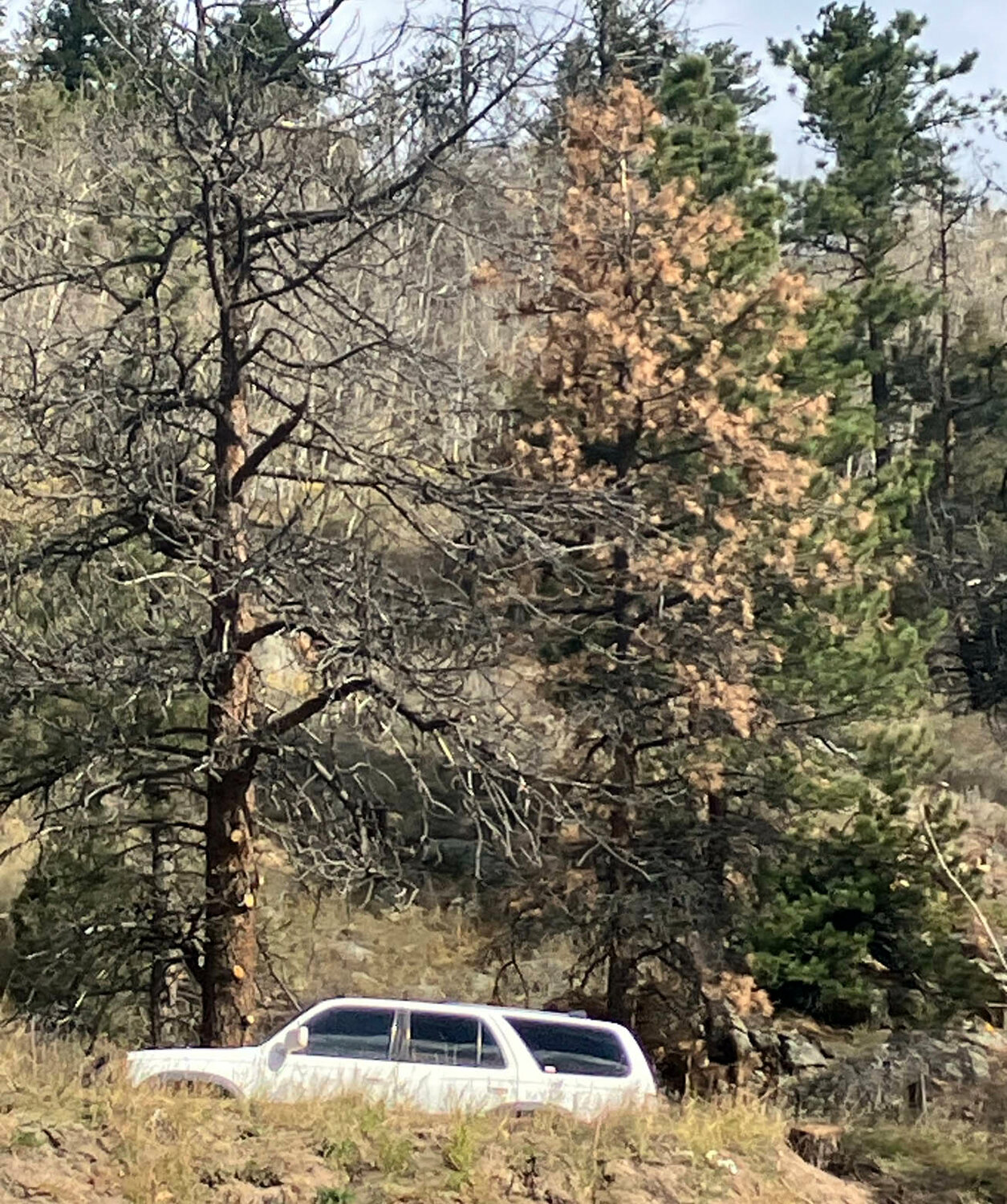
Dead and dying roadside trees in Boulder Canyon
Responsibility for clearing these trees, even for fire mitigation, nearly always falls to landowners, not CDOT.
TUNGSTEN VALLEY - Have you noticed the numerous dead and dying trees along our Peak to Peak highways?
It’s a great example, in a sad way, of the fallout of burning fossil fuels, CO2-induced climate change, and Highway Department safety operations. It leaves the problem of who fire-mitigates the resulting thousands of dead and dying trees.
The Big Picture: Burning fossil fuels boosts atmospheric CO2 and the climate warms and dries. Meanwhile, the Colorado Department of Transportation (CDOT) protects highway safety by applying chemicals to reduce road slickness in freezing conditions.
Roadside trees are stressed by the combined environmental challenges of CO2-induced warming, less moisture, and contamination from cold-weather chemicals’ run-off. Those weakened trees become more susceptible to the ravages of beetle species that bore into their trunks and sicken them with hitchhiking microorganisms.
The trees die. To this correspondent, the visible die-off along Colorado’s highways has been striking. Subsequent to making inquiries with the Colorado State University Extension and the CDOT press office, and collating the voluminous returned materials, we can report the following facts:
Scientific studies, as summarized in a CSU Extension Fact Sheet (No. 7.425), demonstrate that CDOT’s deicing compound, magnesium chloride (MgCl2), is toxic to roadside plants, including trees. The “2” is significant: It means there’s twice as much chloride in this chemical than in ordinary table salt (NaCl). That’s a lot of chlorine.
Roadside soils become contaminated by chloride. CDOT’s literature (for example, “Improving the Performance of Roadside Vegetation”) cites measured roadside chloride soil concentrations ranging between 25 to 324 parts per million, depending on conditions. (The natural background level is essentially zero.)
Absorbed by roots, chloride circulates in a tree’s water-conducting system, concentrating in leaves and needles. The leaves and needles die, the tree is stressed, and it can’t fight off beetle attacks. Eventually a beetle-borne fungus kills a tree that may have been a sapling when Benjamin Franklin was a baby in 1706.
Who’s responsible for fire-mitigating MgCl2-killed roadside trees? This correspondent and his wife recently tackled this problem with more than 25 massive, dead trees on our property within the Highway 119 right-of-way.
CDOT’s stated position in its literature is that it clears trees that are actual or imminent hazards to highway traffic. Otherwise, for most dead or dying roadside trees, CDOT leaves them. If a landowner along a highway needs dead trees removed, even for fire safety, that’s the property owner’s mitigation problem.
So, this month we paid out of pocket for the removal of numerous dead, fire-hazard trees at our place, along Highway 119. Good People Tree Service did it in one day with an experienced crew, a 49-ton, 100-foot boom crane, and an impressive slew of other heavy equipment. Some trees exceeded 10 tons, cleanly lifted out after they were cut. It wasn’t cheap (including our cost of getting the CDOT traffic closure permit and paying a traffic management company for the day), but the fire-ready biomass reduction has us breathing easier. As for those other thousands of dead and dying trees along Colorado highways...who knows?
The author takes climate questions at: Peak2PeakClimate@gmail.com.


