
TUNGSTEN VALLEY - This is the second of a three-part series on sending people to Mars, landing them on Mars, and living on Mars. We’re covering this because the wretched new federal budget bill has NASA supporting a megalomaniacal stunt to put...
This item is available in full to subscribers.
At this time, we ask you to confirm your subscription at www.themtnear.com, to continue accessing the only weekly paper in the Peak to Peak region to cover ALL the news you need! Simply click Confirm my subscription now!.
If you are a digital subscriber with an active, online-only subscription then you already have an account here. Just reset your password if you've not yet logged in to your account on this new site.
Otherwise, click here to view your options for subscribing.
Questions? Call us at 303-810-5409 or email info@themountainear.com.
Please log in to continue |
TUNGSTEN VALLEY - This is the second of a three-part series on sending people to Mars, landing them on Mars, and living on Mars.
We’re covering this because the wretched new federal budget bill has NASA supporting a megalomaniacal stunt to put people on Mars as soon as possible, while terminating most of its science.
Landing people on the moon or a planet is tricky. Conventionally, a dedicated lander (DL) departs from an orbiting mother ship; lands; and ultimately ascends and re-unites with that ship for earth return.
There are good reasons for this orbit-rendezvous method: lander design, development, and testing are independent of the rest of the mission components; the lander is optimized for descent and ascent; and the lander carries down, and returns back to orbit, only the fuel and supplies that are essential for the surface mission.
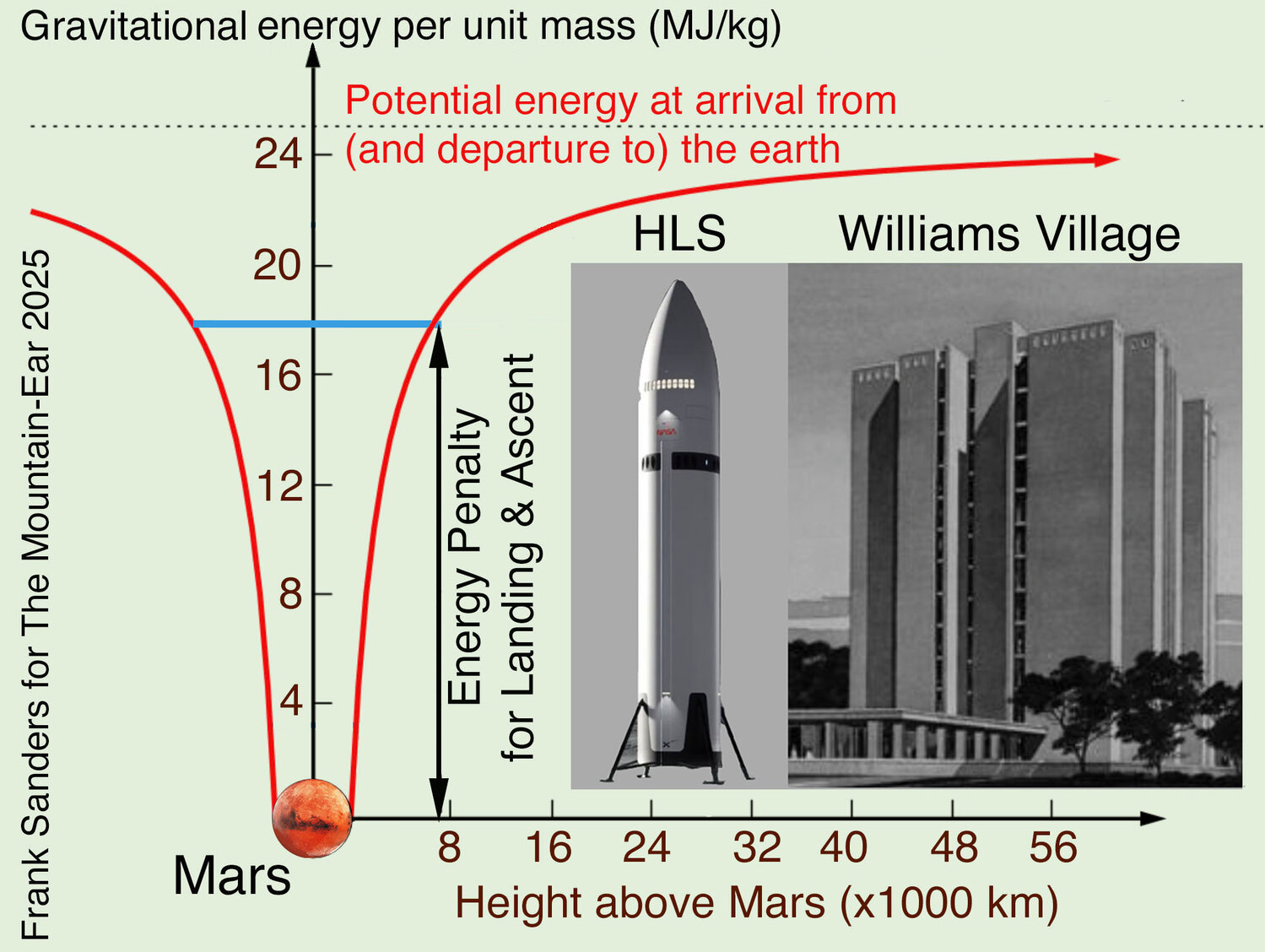
That last point is crucially important. Per this month’s diagram, there is a huge energy penalty for moving stuff between orbit and the surface, which translates into how much fuel is needed for landing and lift-off.
Using a DL keeps most of the mission’s fuel parked up in orbit, without wasting a bunch of it just to move other fuel down and up between orbit and the surface.
This was an issue in 1961-62, when Werner von Braun and NASA were conceptualizing crewed moon landings. NASA engineer John Houbolt told von Braun that using a DL with lunar orbit rendezvous (LOR) with a mother ship wasn’t just a way to do it; rather, he explained to the team, it was the only way they would succeed.
Originally, von Braun had imagined he’d use a giant, tail-first landing rocket that would have to be built and fueled in earth orbit. Switching to LOR with a DL solved the dual problems of vast fuel requirements and landing a giant rocket on its tail.
Fast-forward to 2025. NASA wants to put people back on the moon in the next few years. One aerospace manufacturer underbid its competitors by a factor of two, and NASA bought its proposal. Its design puts an enormous Starship-type Human Landing System (HLS) rocket tail-first on the moon.
The 165-ft (15 story) HLS is supposed to do what von Braun’s team rejected in 1962. It will require 10 to 20 supporting launches just to be fueled in earth orbit. On the moon, its crew will reach the ground via a 120-foot elevator!
The gargantuan lunar HLS is a prototype for landing people on Mars. Because it profligately carries all of the mission’s fuel and supplies down to the surface from orbit and then back up again, it is stunningly large, taller than Williams Village’s highest towers in Boulder, Colorado. Testing it will require sending robotic prototypes to the moon and Mars.
NASA knows they ultimately need a DL for the moon, and eventually for Mars. They have separate contracts, with other companies, for such DLs. The HLS is a stop-gap stand-in because to date nobody has mustered the funding and teamwork to build the needed DLs, and now Congress says America has to rush people to Mars.
Stay tuned for HLS development, to see if it can be built and tested within the scheduling limits set by NASA contracts and the laws of celestial mechanics.
In September skies:
The sun begins the month in Leo, entering Virgo on September 16. On the fall equinox (12:19 p.m. in Nederland on September 22), days equal nights at 12 hours each.
The moon’s dates are: Full (Harvest or Corn Moon) September 7; Last Quarter September 14; New September 21; First Quarter September 28.
September Meteors: The epsilon-Perseid shower (parent an unknown retrograde comet with ~ 1,000 year period) peaks on September 9.
Best Sky Viewing Nights (Minimal Moon): September 15-27.
Sunset (Mid-Month): Deneb is nearly overhead in the east; Vega is overhead; and Altair is in the south-southeast. Hercules with its striking M-13 globular cluster is overhead. Sagittarius, with our galactic center, is low in the south.
Midnight (Mid-Month): Auriga (the Charioteer) with brilliant-white Capella is in the northeast. Perseus is high in the east. Pegasus is nearly overhead while Altair sets in the west.
Sunrise (Mid-Month): Orion is due south. Procyon (Star Before the Dog) is high in the southeast. Cetus (the Whale) is low in the southwest.
Mercury, in Crater between Virgo and Leo, is lost in the sun.
Venus, next to Regulus in Leo, is the Morning Star, low in the east before sunrise.
Mars, next to Spica in Virgo, is very low in the west at sunset, setting just after 8 p.m.
Jupiter, next to Castor and Pollux in Gemini, rises at 1:30 a.m. and is medium-height in the east at dawn.
Saturn, in Aquarius, is low in the east at sunset and low in the southwest at dawn. Find it in binoculars and then pivot upward a couple of moon diameters to see Neptune.
Notable Space Missions: NASA’s Interstellar Mapping and Acceleration Probe (IMAP), which will study the bubble of solar wind surrounding our solar system, will launch from Cape Canaveral this month. At the end of the month, Blue Origin’s New Glenn booster is supposed to make its maiden flight carrying NASA’s Escape and Plasma Acceleration and Dynamics Explorers (Escapade) mission.
Frank Sanders, a spectrum scientist, takes astronomy-related inquiries at backyardastronomy1@gmail.com.


